

Managing rental property finances isn't just about collecting rent and paying expenses. Sometimes, money comes back into your account through refunds, reimbursements, or credits.
Maybe a contractor refunds an overpayment, your insurance company reimburses you for repairs, or a utility provider issues a credit for an incorrect charge.
While these transactions might seem like extra income, recording them incorrectly can distort your rental property's financial performance.
Understanding how to categorize refunds, reimbursements, and credits helps you maintain accurate records, avoid overstating rental income, and prepare cleaner financial reports for tax season.
Although these terms are sometimes used interchangeably, they represent different financial situations.
The important distinction is that not every deposit into your bank account represents rental income.
Some deposits simply reverse an earlier expense or recover money you've already spent.
A refund occurs when a vendor, contractor, or service provider returns money you previously paid.
For example, imagine you paid $1,000 for plumbing repairs, but the contractor later refunded $200 because part of the work was unnecessary.
Your actual repair cost is only $800.
Instead of categorizing the $200 as rental income, record it as a reduction of the original repair expense.
This ensures your financial reports reflect the actual cost of maintaining the property.
Tip: Whenever possible, associate the refund with the same property and expense category as the original transaction.
If the refund relates to a prior tax year, review the earlier deduction before adjusting your current-year records. A previously deducted expense may require different tax treatment.
Tenant reimbursements are common when landlords pay expenses that tenants are responsible for under their lease agreements.
Examples include:
Suppose you pay a $150 water bill and your tenant later reimburses the full amount.
You need to record both transactions accurately.
For many U.S. rental tax situations, tenant reimbursements are reported as rental income, while the related eligible expense is deducted separately.
That means a $150 reimbursement and a $150 deductible utility expense can offset each other in calculating taxable rental profit.
Important: Don't automatically remove the expense simply because the tenant reimbursed you. The correct treatment depends on who incurred the expense, the lease terms, and the applicable tax rules.
Insurance reimbursements can be more complicated because they often involve property damage, repairs, or major improvements.
For example, imagine a storm damages your rental property's roof.
You pay $5,000 for repairs, and your insurance company reimburses you $3,500.
From a cash-flow perspective, the property owner paid $1,500 after the insurance reimbursement.
However, insurance proceeds may affect deductible casualty losses, property basis, or taxable gains. A roof replacement may also be a capital improvement rather than an immediately deductible repair.
Keep the repair invoice, insurance settlement statement, claim information, and reimbursement records together. Consult a tax professional before deciding how to report a substantial insurance payment.
Not every refund appears as a deposit into your bank account.
Sometimes, a company applies a credit toward your next bill.
For example, your electricity provider overcharges you by $75 and applies a credit to the following month's statement.
Your next bill is $200, but you only pay $125.
The accounting treatment depends on how you recorded the original charge. If the $75 overcharge was previously recognized as an expense, the credit generally reduces that expense. If it was already recorded as a receivable, applying the credit clears that balance.
The key is to avoid counting the same credit twice.
Keep the original bill and adjusted statement as supporting documentation, even when the credit doesn't create a separate bank transaction.
Small bookkeeping errors can accumulate and make rental property reports misleading.
A contractor refund generally reduces the cost of the original service rather than representing new rental revenue.
When you own multiple rental properties, reimbursements should be associated with the correct property to maintain accurate property-level reporting.
If a vendor already reduced your next invoice, recording an additional refund could understate your expenses.
Without a connection to the original expense, it becomes difficult to explain why the refund or reimbursement occurred.
A reimbursement may improve your bank balance without increasing your economic profit. However, it may still need to be reported as income for tax purposes.
Managing these transactions becomes more challenging as your rental portfolio grows.
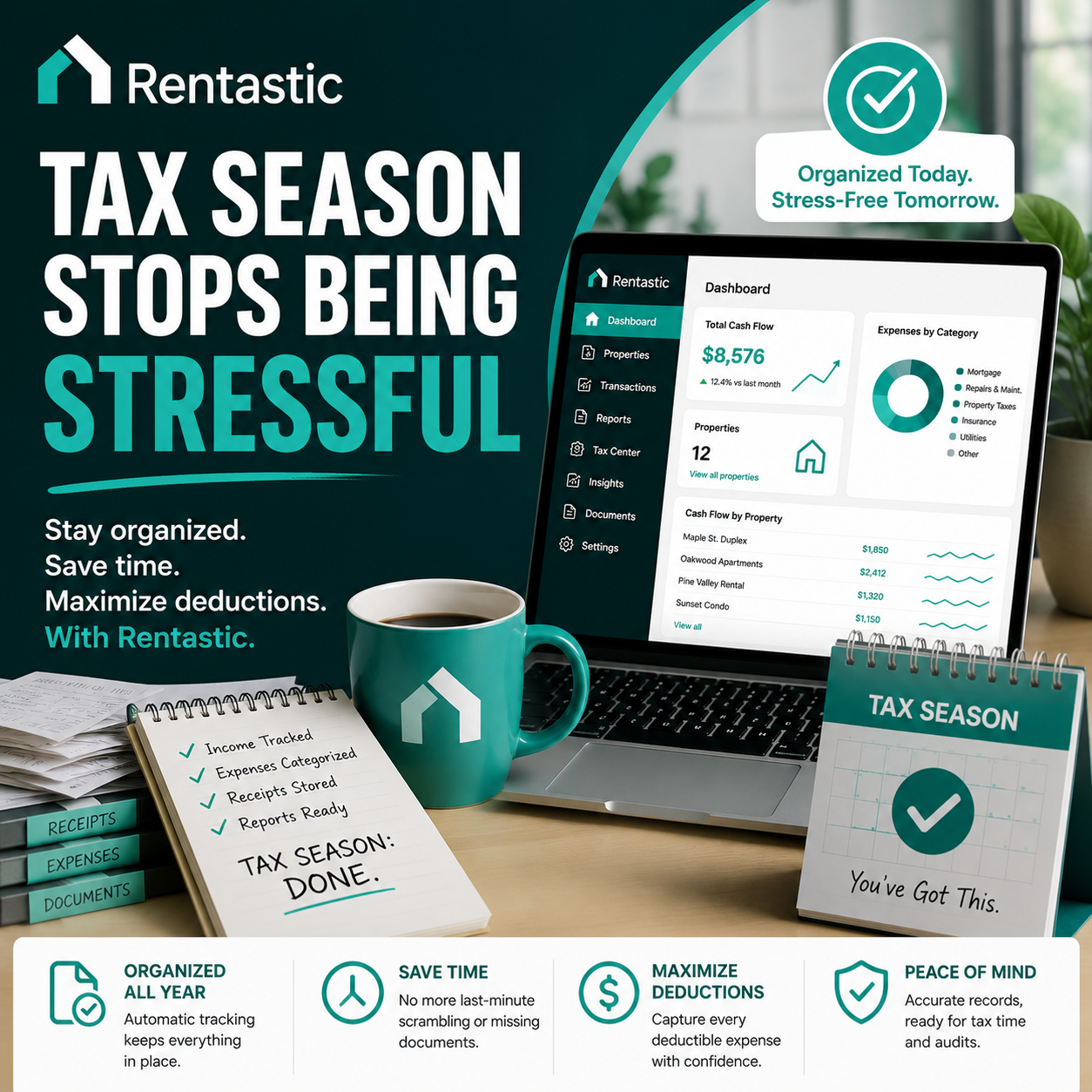
With Rentastic, landlords can organize rental property transactions, categorize income and expenses, and monitor property-level financial performance.
Here's how to keep your records organized:
For transactions that require special accounting treatment, confirm how they should be represented in your records rather than assuming every incoming deposit is ordinary rental income.
A simple monthly review can prevent most refund and reimbursement errors.
Consistently following these steps makes it easier to understand your actual expenses, track money owed to you, and maintain reliable financial records.
Rental property refunds, reimbursements, and credits may seem like minor transactions, but they can significantly affect the accuracy of your bookkeeping.
The most important thing to remember is that money coming into your bank account isn't always new rental profit.
Some transactions reduce previous expenses, others recover costs paid on behalf of tenants, and some require special accounting or tax treatment.
By categorizing these transactions properly and reviewing them regularly, you can maintain clearer financial reports and make better decisions about your rental investments.
Take control of your rental property bookkeeping with Rentastic.
Track your income, organize expenses, and keep your rental property finances in one place.
RECENT POSTS


© 2025 Rentastic
Rentastic is registered as a trademark. Terms and conditions, features, support, pricing, and service options subject to change without notice.



























































































Comments