

Security deposits are a normal part of managing rental properties, but they can easily create confusion in your financial records.
When a tenant pays a security deposit, the money enters your bank account just like rent. However, a security deposit is not automatically rental income. In most cases, it's money you're holding temporarily and may need to return when the tenant moves out.
If you mistakenly record security deposits as rental income, you could inflate your property's profits, miscalculate cash flow, and create unnecessary complications during tax season.
Here's how to track security deposits correctly, keep your rental bookkeeping organized, and avoid mixing money you owe tenants with money you've actually earned.
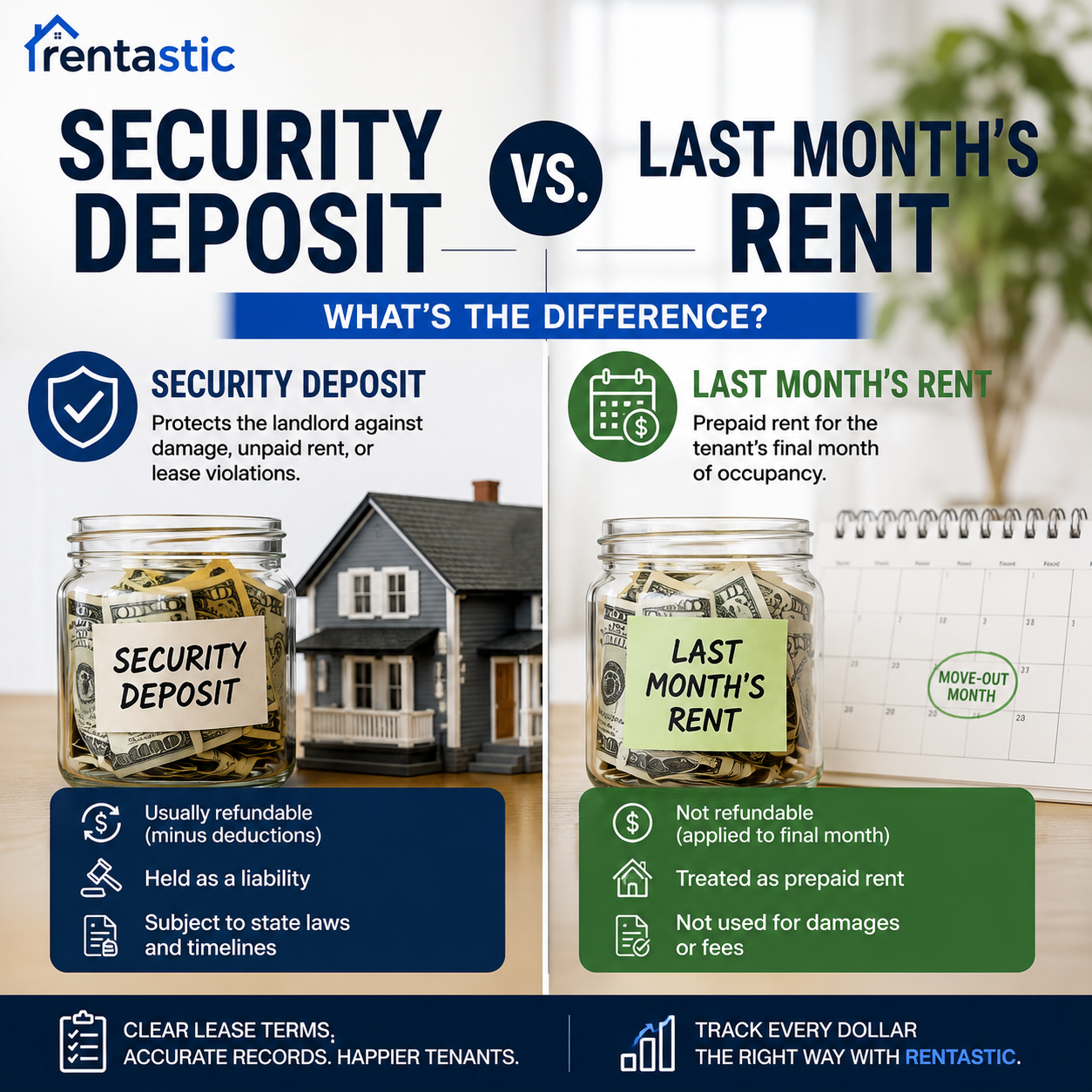
A security deposit is money collected from a tenant to protect the landlord against certain financial losses, such as unpaid rent or property damage beyond normal wear and tear, subject to applicable laws.
Unlike monthly rent, a refundable security deposit generally remains the tenant's money until the landlord has a legal right to retain some or all of it.
From an accounting perspective, this makes the deposit a liability rather than income.
Here's the difference:
For example, imagine a tenant moves into your rental property and pays:
Although $3,600 enters your bank account, only $1,800 represents rental income.
The remaining $1,800 should be tracked separately as a refundable security deposit liability.
This distinction is important because money in your bank account doesn't always represent money you've earned.
Recording security deposits as rental income may seem harmless, especially if you're managing only one or two properties.
However, the accounting errors can become significant as your portfolio grows.
If you collect $20,000 in rent and $4,000 in refundable security deposits, recording everything as income makes your reports show $24,000 in revenue.
That creates an inaccurate picture of your property's performance.
Security deposits increase your available bank balance, but they don't necessarily increase the amount of money you can spend.
If you owe tenants $8,000 in refundable deposits, that money may need to remain available for future refunds.
Under general U.S. federal tax rules, refundable security deposits aren't taxable rental income when received if you intend to return them.
However, deposits applied to unpaid rent or retained for certain other reasons may become taxable income.
Incorrectly categorizing deposits can lead to reporting mistakes.
Without a clear record of each tenant's deposit, you may struggle to determine how much should be returned when someone moves out.
That becomes especially challenging when managing multiple tenants or properties.
The simplest approach is to treat security deposits as a separate financial category rather than including them in your regular rental income.
In your accounting records, establish an account called Security Deposits Held or Refundable Tenant Deposits.
This account should track how much you owe tenants.
When a tenant pays a refundable $2,000 deposit, the accounting entry is:
Your bank balance increases, but your rental profit remains unchanged.
If your bookkeeping software doesn't support liability accounts, maintain a separate security deposit ledger and make sure the deposit isn't included in rental income reports.
Every deposit should be connected to the correct tenant and rental property.
At a minimum, record:
For landlords managing multiple properties, tracking deposits individually prevents confusion when tenants move out at different times.
Some states require landlords to hold security deposits in designated accounts, while others have different rules.
Even when separate bank accounts aren't legally required, keeping deposits distinguishable from operating funds can simplify bookkeeping.
For example, you might maintain an operating account for rent and expenses and a separate deposit account for refundable tenant funds.
Remember that a separate bank account doesn't replace the need to track the deposit as a liability in your accounting records.
When a tenant moves out and you return their full deposit, the refund should reduce the deposit liability rather than appear as a rental operating expense.
Suppose you collected a $1,500 deposit and returned the full amount.
Your accounting records should show:
This prevents deposit refunds from artificially reducing your property's reported profitability.
Not every security deposit is returned in full.
Depending on your lease and local laws, you may be permitted to retain part of a deposit for unpaid rent, eligible damages, or other authorized charges.
Consider this example:
The original $2,000 was recorded as a liability.
When the tenant moves out, the liability is cleared by allocating $500 to unpaid rent, $300 to eligible damage charges, and $1,200 to the refund.
For bookkeeping purposes, the retained amounts should be categorized appropriately, with any related repair costs recorded separately to avoid double counting.
For U.S. federal income tax purposes, security deposit amounts you keep generally become income when retained or applied, subject to the circumstances and applicable tax rules.
Important: Normal wear and tear generally cannot be deducted from a tenant's security deposit. Always follow your state's rules regarding deductions, documentation, deadlines, and refunds.
Even experienced landlords can make mistakes when tracking tenant deposits.
Here are some of the most common problems to watch for.
Mistake #1: Categorizing deposits as rent
A refundable deposit isn't rent just because the tenant paid it alongside the first month's rent. Separate the amounts when recording the transaction.
Mistake #2: Treating refunds as expenses
Returning a refundable deposit generally settles a liability. It shouldn't reduce your property's operating profit.
Mistake #3: Forgetting to track partial deductions
If you retain part of a deposit, document the reason, amount, and corresponding accounting entry.
Mistake #4: Combining deposits from multiple tenants without individual records
Even if deposits are held in one bank account, you should know exactly how much belongs to each tenant.
Mistake #5: Spending refundable deposit funds
A large bank balance can be misleading if part of that money is owed to tenants. Keep deposit obligations visible so you're prepared when refunds become due.
Security deposits shouldn't be something you review only when a tenant moves out.
Including them in your monthly bookkeeping routine can help you catch mistakes before they affect your financial reports.
At the end of each month, check whether:
A few minutes of regular review can prevent larger accounting problems later.
Keeping rental income separate from other financial activity is an important part of accurate property bookkeeping.
Rentastic helps landlords organize rental transactions, assign transactions to properties, and monitor property-level financial performance.
With Rentastic, you can:
For refundable security deposits, use an appropriate non-income categorization approach and maintain a separate liability ledger when needed. Rentastic's transaction categorization should not be treated as a substitute for dedicated security deposit liability accounting or tenant-by-tenant deposit tracking.
The goal is simple: your rental income reports should reflect what your properties actually earn, not every dollar that enters your bank account.
Security deposits may look like rental income when they first arrive, but they serve a completely different financial purpose.
They're generally refundable funds held on behalf of tenants, not money you've earned from operating your rental property.
By recording deposits as liabilities, tracking balances individually, documenting deductions, and handling refunds correctly, you can maintain more accurate financial records.
This becomes even more important as your rental portfolio grows.
Better security deposit tracking means cleaner bookkeeping, more reliable profit reports, and fewer surprises when tenants move out.
Want a clearer view of your rental property's finances?
Try Rentastic to organize your rental transactions, monitor income and expenses, and simplify your day-to-day rental bookkeeping.
RECENT POSTS


© 2025 Rentastic
Rentastic is registered as a trademark. Terms and conditions, features, support, pricing, and service options subject to change without notice.





























































































Comments